InsightsDesign for AllEssay
Why is Design for All not Universal Design?
Design for All and Wikipedia: why it is not Universal Design
Italian Wikipedia presents Design for All as a variant of Universal Design, which in Design for All Italia’s view is a fundamental error. The state of the entry in 2026, the Stockholm definition and three differences: in nature, in the role of people, and in how dignity is judged.
· updated 4 min read

Design for All and Universal Design are not synonyms. They work in the same direction – improving independence and quality of life – but they come from different traditions and texts. Universal Design is based on seven principles formulated in the United States in 1997, which guide the design and evaluate its outcome. Design for All, developed in Europe by EIDD since 1993 and defined by the 2004 Stockholm Declaration, is a holistic process that requires people to be involved at every stage of the design. That is why, in Design for All Italia’s view, presenting Design for All as a variant of Universal Design is an error of approach even before it is an error of definition.
What Wikipedia says today (checked in October 2026)
For several years some members of the Associazione Design for All Italia (opens in a new tab) have tried to correct the Wikipedia entry (opens in a new tab) available online. Despite repeated attempts, Wikipedia has rejected the corrections and a deep misunderstanding persists. Comparing or equating Design for All with Universal Design is wrong precisely because they are profoundly different design approaches. Universal Design, Design for All, Inclusive Design (opens in a new tab), Human-Centred Design (opens in a new tab) and many other design approaches work in the same direction: improving quality of life and independence, enabling people. Each discipline has its own particular features, with precise and shared characteristics.
As of 29 October 2026, the Italian Wikipedia entry “Universal design” presents “Progettazione per tutti” (Design for All) as a “variante correlata” [‘related variant’] of Universal design and describes it as a “filosofia progettuale” [‘design philosophy’] (our translation); it quotes the first sentence of the Stockholm Declaration and lists the seven principles of North Carolina State University. This is a step forward compared with the past, but the premise remains: Design for All appears as an offshoot of another approach, and the involvement of people, which is its defining requirement, is not mentioned.
The reference definition
The official definition, in the EIDD Stockholm Declaration of 2004 (opens in a new tab), opens as follows: “Design for All is design for human diversity, social inclusion and equality.”
The full text, with further discussion, is on the page that sets out the full definition in the Stockholm Declaration. The decisive passage for this comparison is the last: the practice of Design for All makes conscious use of the analysis of human needs and aspirations and requires the involvement of end users at every stage in the design process.
It is immediately clear that the 7 principles of Universal Design are fairly distant from Design for All, and rather close to some principles of contemporary ergonomics. On one side we are talking about a holistic approach, and therefore about interdisciplinary knowledge; on the other, about following and applying a list of instructions. Tick off the checklist, and the project becomes “Universal Design oriented”. What is more, Design for All involves end users and all stakeholders; the seven principles of Universal Design do not provide for people’s participation in the design: dignity appears there as a requirement of the outcome – avoiding segregation and stigma – not as the result of a process shared with the people who will use the solution.
Three substantial differences
The first difference is one of nature: a process on one side, a set of principles to guide and evaluate the design on the other. The second concerns people: Design for All involves them at every stage and gathers both their expressed and their latent needs, while the principles of Universal Design do not provide for their involvement.
The third concerns how dignity is judged. Universal Design treats it as a requirement to be met. Design for All tests it with people, in terms of comfort and pleasure of use, because only the person who uses a solution can say whether they would choose it. The full comparison, which also covers Inclusive Design, is in the article Design for All, Inclusive Design, Universal Design: design approaches compared.
The Design for All process
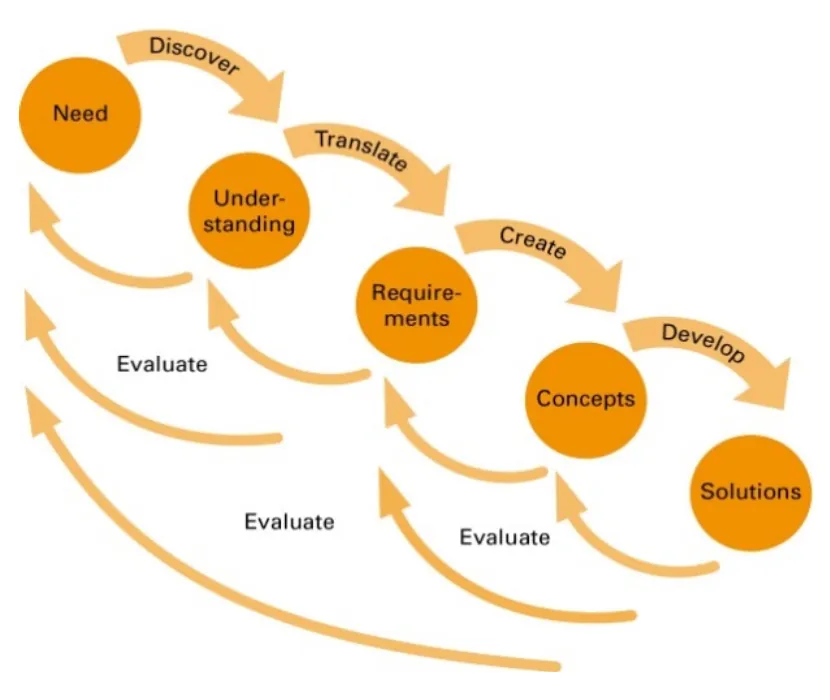
On this last point Design for All is more relevant than ever: in 2004, when Co-Design was not yet common practice in the design of products and spaces, the Stockholm Declaration already made it a requirement. Involving people makes it possible to gather and analyse latent needs too, which no list of requirements captures, and to look for one or more appropriate solutions.
The diagram reproduced in this section is the waterfall model from the University of Cambridge’s Inclusive Design Toolkit: the stages follow one another, but each is evaluated again.
On the importance of the process and how to apply it, see our page on the Design for All process: participants are not involved passively, simply to validate the design, but are encouraged to contribute their own experience and creativity. The people involved are fundamental, and no design approach can do without them any longer.
This is the process we follow in our Design for All and Inclusive Design consultancy for companies, public bodies and designers.
In our projects
- OpenCo-Design
- DemìCo-Design · Design for All
- GiottoDesign for All
- ShadeDesign for All
- FlightCo-Design · Design for All
- PrimeCo-Design · Design for All
- ShineDesign for All
- FlatDesign for All
- DfA ItaliaCo-Design · Design for All
- Accessible museumsCo-Design · Design for All
- HackabilityCo-Design
- SherlockCo-Design · Design for All
Read next
- News and eventsDesign for All Process: the Florence event of 17 October 2026What did the Design for All Process event in Florence bring together?
- InterviewInclusive design: the Design for All approach on Radio Canale ItaliaWhat is inclusive design, as explained on the radio?
- InterviewFrancesco Rodighiero on Rai Radio 3: Design for All at the heart of the cultural debateWhy is Design for All a cultural issue, not only a technical one?
People in the design process
If your project needs to involve the people who’ll use it from the start, we can help you plan the process and test it with them.