InsightsDesign for AllNews and events
What did the Design for All Process event in Florence bring together?
Design for All Process: the Florence event of 17 October 2026
A network of museums, a mass-produced industrial product and artificial intelligence technologies in the same afternoon: the programme of Design for All Italia’s event in Florence. In each case there is a point beyond which inclusion can no longer be designed, only remedied.
· updated 5 min read
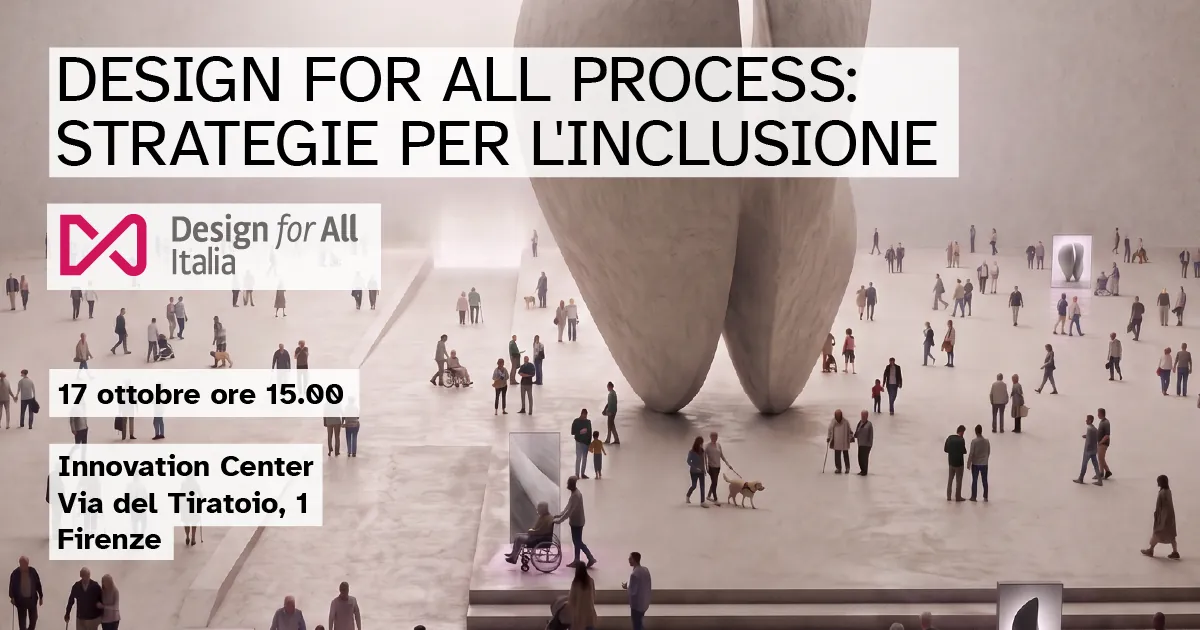
Design for All Process: strategie per l’inclusione [‘strategies for inclusion’] brought to Florence, on Saturday 17 October 2026, three scales of design that are rarely discussed in the same afternoon: a network of museums, a mass-produced industrial product and artificial intelligence technologies. The event, organised by the association Design for All Italia (opens in a new tab), was scheduled at the Innovation Center (opens in a new tab) in Florence, entrance at Lungarno Soderini 21, in collaboration with Toscana Accessibile (opens in a new tab) and Codesign Toscana (opens in a new tab). Here we set out the programme and the reasons for the meeting; the page will be updated with the materials and outcomes of the day.
Design for All is not a procedure to be applied as well as possible to a project that has already been set up. It is the way the project is looked at from the very beginning: who it is being designed for, who takes part in decisions, what counts as a meaningful result. The process is the practical consequence of that way of looking, not a substitute for it.
Hence the thread that linked the three cases of the day. In each, there is a point beyond which inclusion can no longer be designed, only remedied. Where that point falls changes; the fact that it exists does not.
We are not neutral about this event. Francesco Rodighiero is president of the association Design for All Italia and organised the meeting; our studio worked on both design cases on the afternoon’s programme, the Bologna Civic Museums system and the user interface of BTicino’s Linea 5000. Readers can weigh what follows accordingly.
Design for All Process: strategie per l’inclusione, Innovation Center, Florence, 17 October 2026
Twelve civic museums, one way of looking
The first talk on the programme was a preview of the publication on the Bologna Civic Museums (Musei Civici di Bologna) (opens in a new tab). Twelve sites differing in period, location and conservation constraints, approached as a single system: staff training, Co-Design workshops with communities, accessibility guidelines. The work, carried out by Design for All Italia in collaboration with the Department of Architecture of the University of Ferrara, involved more than 150 participants in 3 training and initial listening sessions and more than 10 Co-Design workshops, with more than 80 anonymous questionnaires. More than 400 needs emerged; they were organised into 6 thematic and operational areas and set out in more than 15 main documents and technical annexes: the design guidelines and the plans drawn up under the ministerial guidelines for museums, libraries and archives. A summary of the project is also in our portfolio.
The resulting guidelines are not a handbook of solutions to be transferred from one site to another. No solution survives the move from a listed historic palazzo to a contemporary building intact. What transfers is the criterion by which needs are read and responses assessed, and this holds even for sites that nobody has yet examined. A museum that complies with the regulations is not yet a museum everyone can experience, and no final inspection closes that gap.
The approach at the scale of the industrial product
The second case was BTicino Linea 5000 (opens in a new tab), where the same way of looking meets the constraints of industry. Our contribution concerned the device’s user interface: UX and UI analysis and design, covering the sequence of actions required, the legibility of the controls and the clarity of the feedback given to the person using them.
Here the point of no return comes before the moulds are made. The physical part of an interface cannot be corrected with a software update: it stays installed in the wall for years, and any error is repeated in every unit produced. What changes is the weight of the decisions, not what you look at when deciding.
Placing the two cases side by side in the same afternoon was not meant to prove that a procedure works in different contexts. It was meant to show that the design attitude remains recognisable when the constraints change radically. It is the way of looking that is stable; the solutions are different every time, and they must be.
Voices from the network
The programme then included short talks by members and professionals from the Design for All Italia network on practical applications in different contexts: Marco Berni (Codesign Toscana), Letizia Bonatti (AIPI), Erica Gaiatto and Elisabetta Schiavone (CERPA Italia ETS), Carla Giusti (Design for All Italia). Speakers were also asked to cover the difficulties they had met, because the resistance a project encounters says more than its successful solutions about how the problem was framed at the start.
Accessibility and artificial intelligence: the dialogue with Paolo Barberis
The conversation with Paolo Barberis was scheduled to close the main programme. Founder of Dada, co-founder of the Florence-based accelerator Nana Bianca and innovation adviser to the Italian Prime Minister’s Office from 2014 to 2018, Barberis brings the perspective of someone who builds digital businesses.
It is worth remembering, though, where he comes from: an education in architecture, in Italy and Germany. It is the same design root as that of people who work for human diversity. The dialogue was therefore conceived not as a meeting between two unrelated worlds, but between two ways of handling the same material – the interface between a person and a system – at a time when artificial intelligence technologies are redefining the practical conditions of independence: wayfinding, understanding, language mediation, relationships with services.
Design for All certification
The last item on the programme was a public report on the association’s work towards a certification scheme of its own, in response to growing demand from public and private clients. The morning workshop, reserved for members, was devoted to the open questions: what is certified, who verifies it and with what independence, on the basis of what documentation. This is the instrument the association intends to establish through the amendment to its statutes announced for December 2026; it is not yet an operational certification.
Materials
The programme of the day is published in the news item on the association’s website (opens in a new tab), in Italian.
Other cases in which the Design for All process has taken shape are collected in our case studies. To apply it to a museum, a product or a service, the page on Design for All and Inclusive Design consultancy describes how we work.
In our projects
Read next
- InterviewInclusive design: the Design for All approach on Radio Canale ItaliaWhat is inclusive design, as explained on the radio?
- InterviewFrancesco Rodighiero on Rai Radio 3: Design for All at the heart of the cultural debateWhy is Design for All a cultural issue, not only a technical one?
- News and eventsDesign for All Italia: a new section in our portfolioWhich projects has the studio developed with Design for All Italia?
Designing before the point of no return
Museums, products and services: we work so that inclusion enters the project while it can still be designed, not when all that is left is to put things right.