InsightsProducts and spacesInterview
How does design change when people take part?
Participatory design for change: Francesco Rodighiero in Il Bagno Oggi e Domani
A society of five generations that is ageing rapidly can no longer be designed for a single category of people. Francesco Rodighiero’s interview in Il Bagno Oggi e Domani, the updated demographic data and the role of participatory design in companies’ research and development.
· updated 3 min read
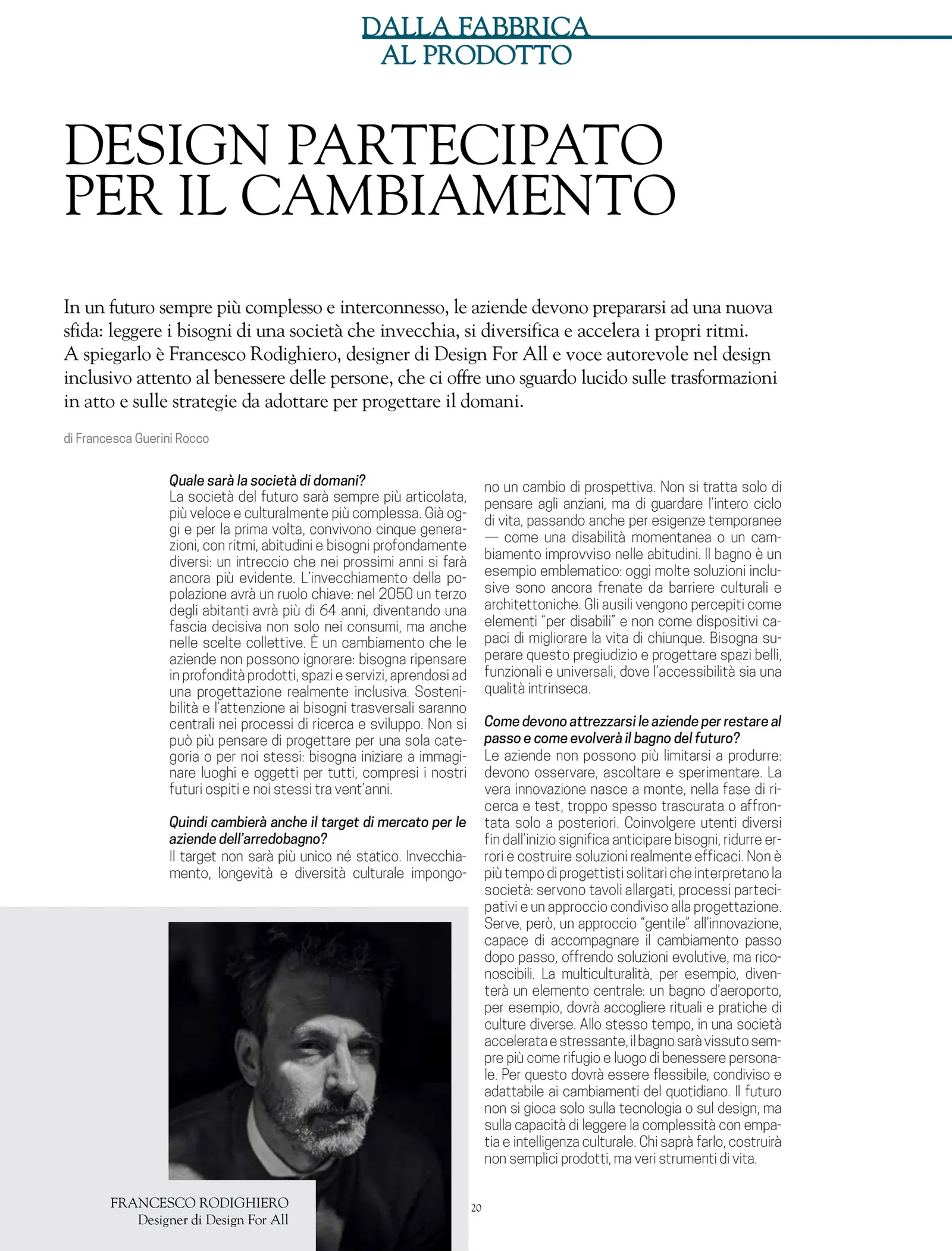
Designing for a single category of people, or for ourselves, is no longer possible: this is the argument Francesco Rodighiero makes in the interview published by Il Bagno Oggi e Domani in its November–December 2025 issue. A society in which five generations live side by side, with different rhythms and habits, and in which the population is ageing rapidly, needs places and objects designed for everyone. Participatory design, which involves people from the start of the process, is how to get there without solutions that reflect only the designer’s own point of view.
The interview, by Francesca Guerini Rocco, appeared in issue 351 of the magazine Il Bagno Oggi e Domani (digital edition) (opens in a new tab), which presents Francesco Rodighiero as a “Design for All designer and an authoritative voice in inclusive design that cares about people’s well-being” (our translation). The conversation focuses on the demographic, cultural and behavioural changes that will decisively shape the world of design in the years ahead.
A more complex, older society
Rodighiero points out that “the society of the future will be increasingly varied, faster and more culturally complex”, a condition made evident by the fact that five generations, with very different rhythms and habits, now live side by side. Population ageing is, in his view, one of the most important factors: “By 2050, one third of the population will be over 64”, an age group that will carry real weight not only in consumption but also in collective decisions.
Note, 29 October 2026. The figure cited in the interview matches the projections for Italy: according to the Istat press release of 31 August 2026 (opens in a new tab), people aged 65 and over made up 24.7% of the population on 1 January 2025 and will make up 34.5% in 2050. European data are collected on the page Ageing and disability in Europe: the data.
 (opens in a new tab)
Designing for everyone, with people
Hence the need, which can no longer be put off, to rethink design as an open and inclusive process. Rodighiero is clear: “We can no longer think of designing for a single category or for ourselves: we have to start imagining places and objects for everyone.” It is an approach that takes in people’s entire life course, including temporary frailties and situations in which changing habits call for new systems, new products or simply new ways of living in spaces.
Research and development in companies
The interview also highlights the central role that research and development will have to play within companies. In Rodighiero’s view, sustainability, adaptability and attention to needs shared across different groups of people become the cornerstones of contemporary design. Participatory design, understood as structured listening and a responsible interpretation of needs, is an essential tool for avoiding solutions that reflect only the designer’s viewpoint and for creating social value.
Rodighiero’s contribution is part of a broader dialogue on the future of bathroom furnishing and the innovation scenarios ahead for the sector. His perspective is a reminder that design cannot simply respond to today, but must anticipate tomorrow with a vision able to include differences, diversity and everyday change.
Read the full issueThe magazine (opens in a new tab)
For our studio this is also a choice of process. In Design for All, as in Inclusive Design, two distinct approaches, involving people through Co-Design is not a final check: it comes at the start and returns throughout the process, which does not move in linear phases but through successive rounds of dialogue.
In its September–October 2026 issue the same magazine published “Anche per me” (‘For me too’), an accessible and inclusive bathroom that grew out of a process of listening and participation. To apply this approach to products, spaces and services, the page on Design for All and Inclusive Design consultancy describes how we work.
In our projects
Read next
- Essay“Anche per me”: an accessible, inclusive bathroom in 5.5 square metresHow do you design a bathroom for everyone in 5.5 square metres?
- EssayThe inclusive bathroom as a system: the Design for All approachWhy should an inclusive bathroom be designed as a system?
- EssayAccessible architecture: innovation and inclusion in public and private spacesHow do you design accessible architecture that goes beyond the regulations?
Designing with the people who will use the result
Bathroom products, spaces and services: with companies, we build processes in which people take part from the very beginning.