InsightsProducts and spacesEssay
How do you design a bathroom for everyone in 5.5 square metres?
“Anche per me”: an accessible, inclusive bathroom in 5.5 square metres
A double washbasin, an open shower with two seats, just three grab rails: a home bathroom that does not look like a “disabled bathroom”. The Prime washbasin, the floor-standing WC and DM 236/1989, contrast and light, the feature in Il Bagno Oggi e Domani and INOUT 2026.
· updated 5 min read
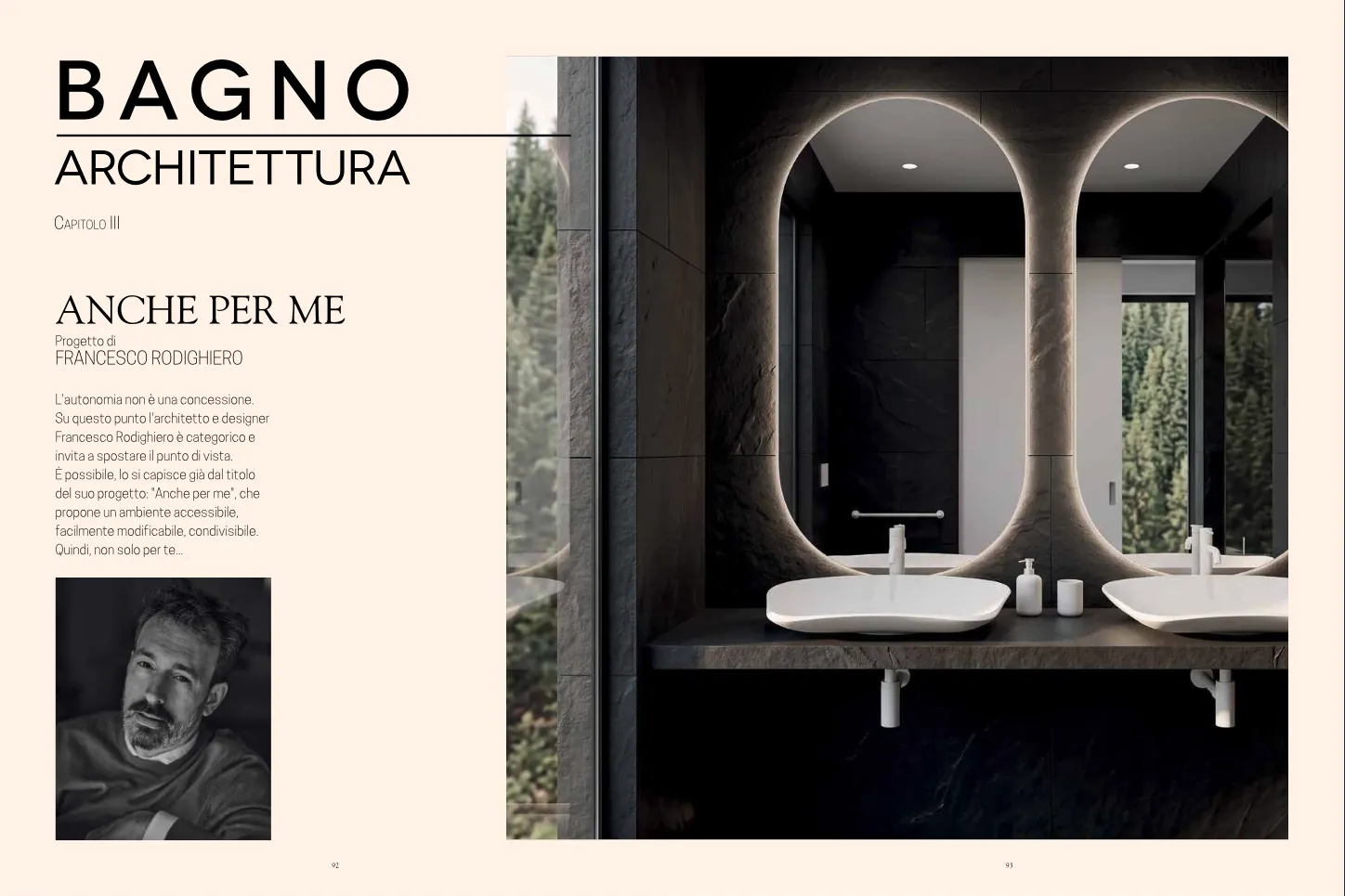
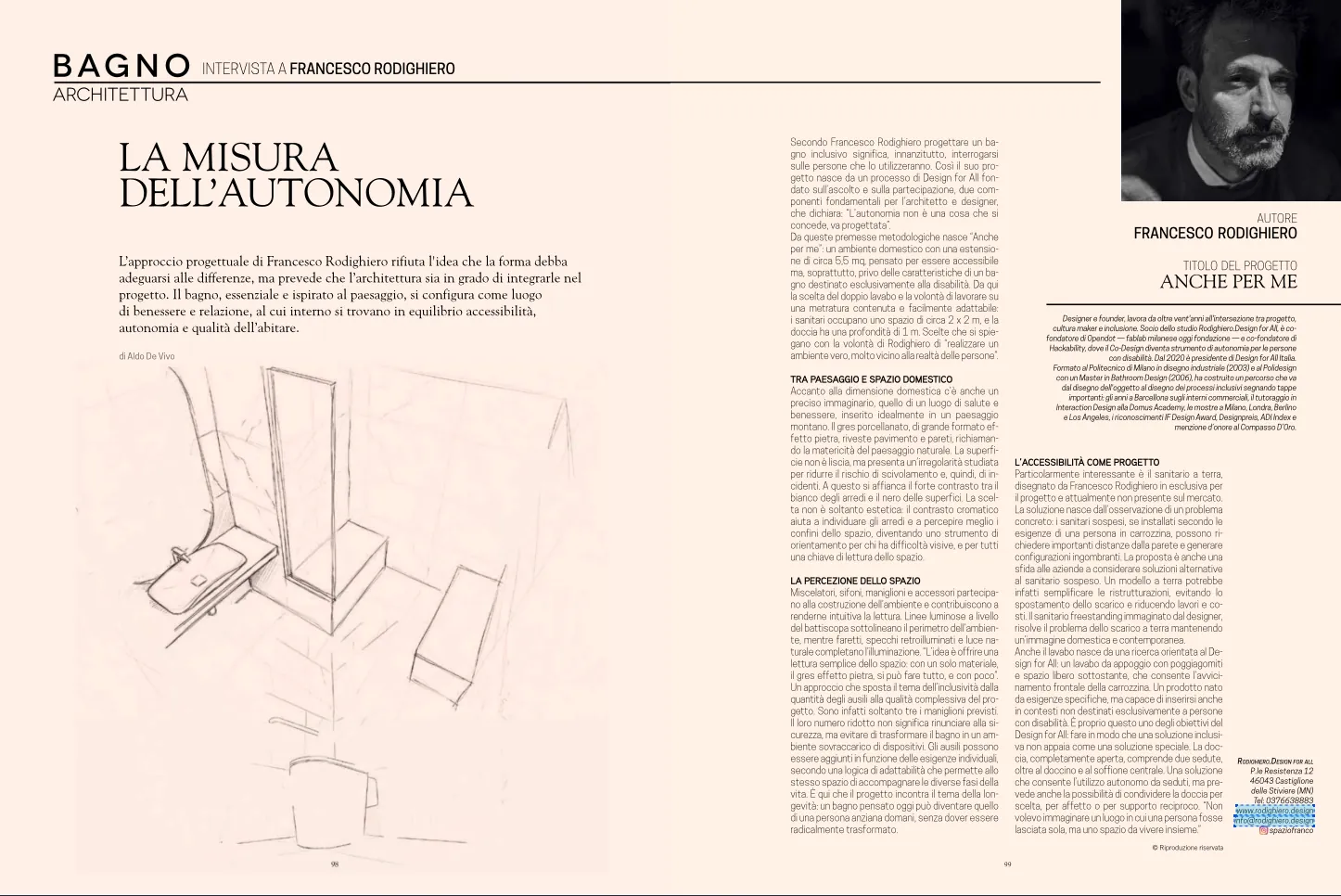
“Anche per me” [‘For me too’] is an accessible, inclusive bathroom of around 5.5 m², designed by Francesco Rodighiero: a home bathroom that does not look like a “disabled bathroom” and that can accompany the different stages of life without major alterations. Issue 356 of Il Bagno Oggi e Domani (September–October 2026) devotes eight pages to it in its Bagno Architettura section.
An accessible bathroom in 5.5 square metres
“Anche per me” grows out of a Design for All process based on listening and participation. The aim is an accessible bathroom that does not look like a “disabled bathroom”, but an inclusive, homely one, close to the way people actually live. In around 5.5 m² there is room for a double washbasin, an open shower with two seats and only three grab rails. More aids can be added over time, as the needs of the people living there change, so that the same room can accompany the different stages of life without major alterations.
The Prime washbasin
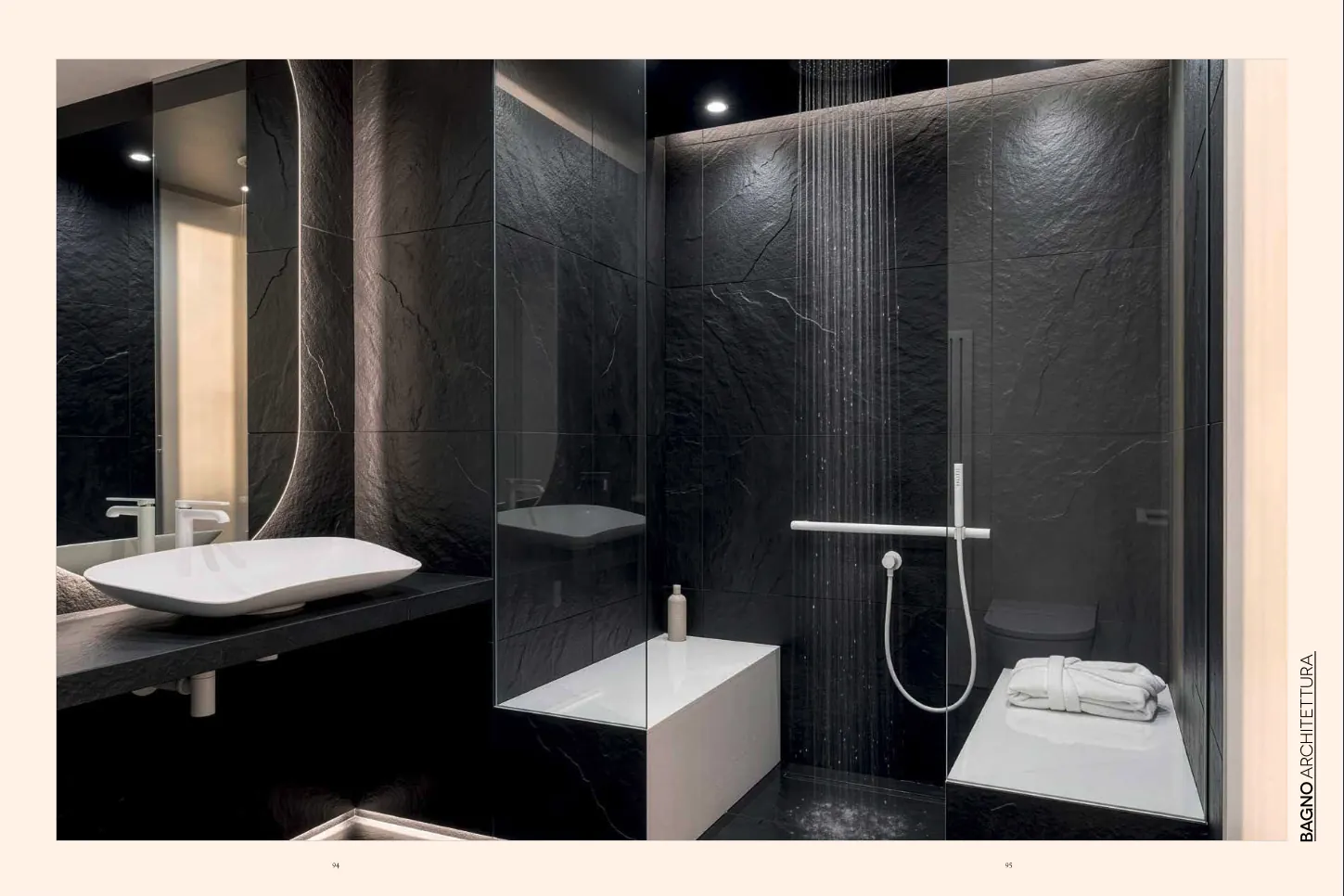
The first element is the Prime countertop washbasin by Goman (opens in a new tab), in white Politek, designed by Francesco Rodighiero. It grew out of research into how people actually use a washbasin. An integrated elbow rest and clear space underneath allow a wheelchair user to approach from the front. It meets specific needs without calling for a dedicated bathroom: it can be fitted in an ordinary home bathroom. In other words, it is an inclusive solution that does not present itself as a special one.
The floor-standing WC and DM 236/1989
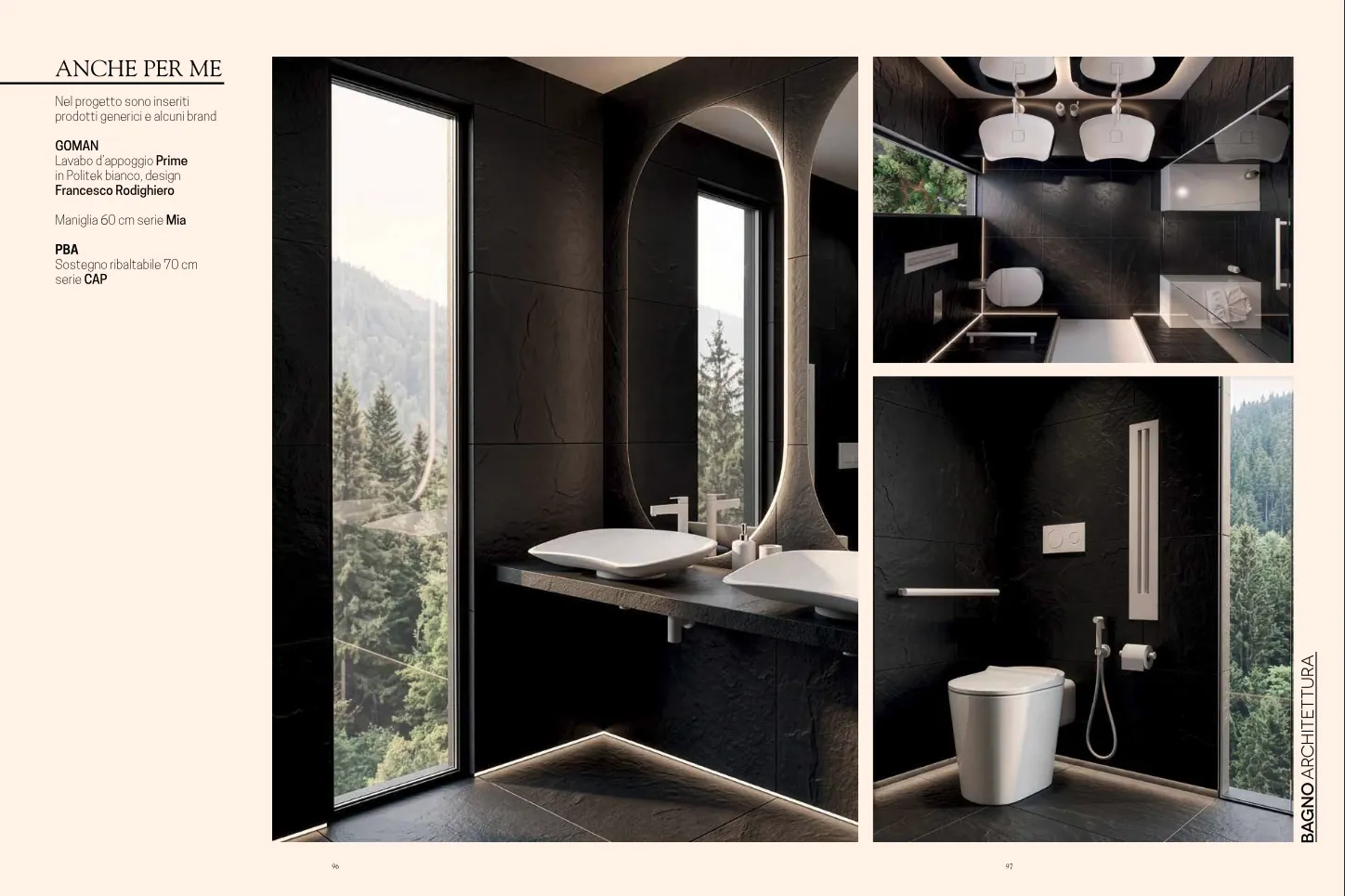
The second element is a floor-standing WC that Francesco Rodighiero designed for this project, because no available alternative was suitable or matched the quality of the design. It is currently a concept, not yet in production. The choice starts from a practical problem. For transfer from a wheelchair, DM 236/1989 (opens in a new tab) (Italy’s Ministerial Decree on accessibility) requires the front edge of the bowl to be 75–80 cm from the rear wall. With a wall-hung WC, this distance often calls for dedicated models or false walls that project into the room. The floor-standing WC in “Anche per me”, by contrast, is 75 cm deep: installed flush against the rear wall, it reaches the required distance through its own depth.
The same decree, at point 8.1.6, states a preference for wall-hung fittings. Choosing a floor-standing WC is therefore a design decision, not an oversight: in a 5.5 m² bathroom, the centimetres a false wall would take up matter more than habit. The required distance is achieved through the depth of the WC itself and the way it is installed, with nothing added.
In a renovation it also allows the existing floor outlet to be kept, with less work and lower costs. This also leads to a proposal to manufacturers in the sector. The floor-standing WC can once again be an alternative to the wall-hung model, with a homely, contemporary image.
Contrast and light
The contrast between the black stone-effect porcelain stoneware and the white fittings is above all functional. It helps people recognise the elements and boundaries of the space, especially those with visual impairments. The lighting follows the same logic: skirting-level light lines, backlit mirrors and natural light make the room easy to read.
The publication
The editorial team also took the September–October issue to Cersaie 2026 in Bologna, from 21 to 25 September. For our studio this is an important milestone, because the magazine speaks every day to designers and companies in the sector.
Aldo De Vivo wrote the interview that accompanies the project. In it, Francesco Rodighiero sums up the premise of the work: “Independence isn’t something you grant. It’s something you design for.”
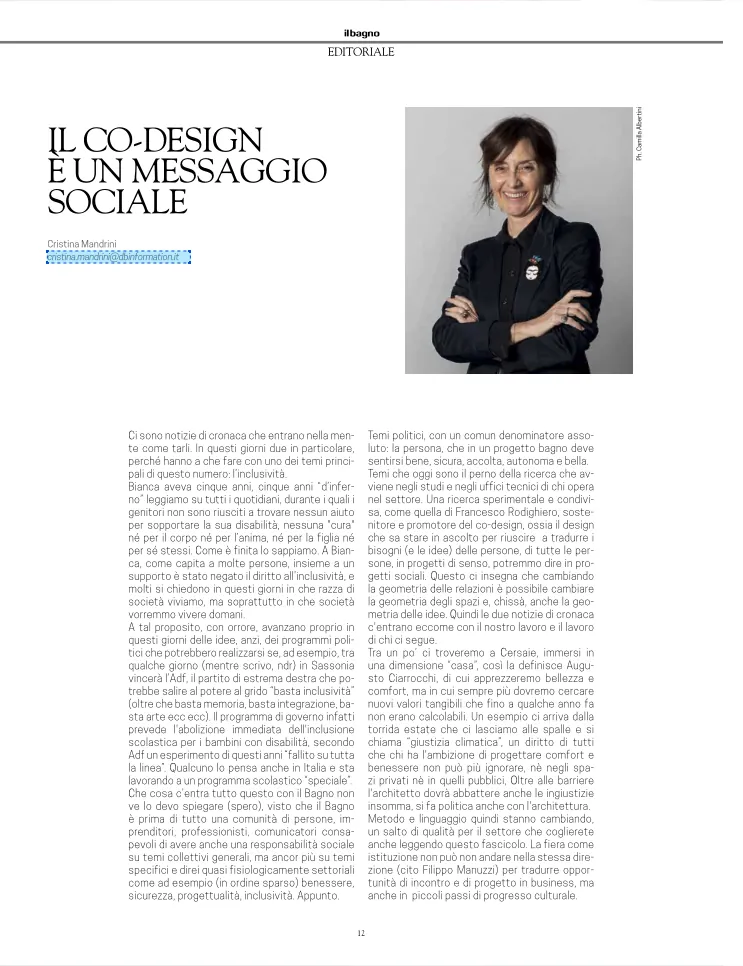
Co-Design in the issue’s editorial
Cristina Mandrini’s editorial opens the issue under the title “Il Co-Design è un messaggio sociale” [‘Co-Design is a social message’]. It cites Francesco Rodighiero’s work as an example of experimental, participatory research: design that listens to people and turns their needs into a project. The reference also reflects our ongoing dialogue with the editorial team, who have followed other projects and talks of ours on Co-Design.
For us this is the most significant sign in the whole issue: Co-Design is moving beyond specialist circles and into the cultural debate of a trade magazine. This interest confirms a conviction that guides our work. Inclusion is not a separate chapter: it is a quality of the design.
INOUT 2026: the presentation in Genoa
The project will also be presented in person. On Thursday 5 November 2026 Francesco Rodighiero will speak at INOUT 2026 in Genoa, at Palazzo della Meridiana. The conference is organised by Il Bagno Oggi e Domani and this year is devoted to future paradigms for designing well-being. At 2.30 pm he will give the talk “Dal design for all al design for us” [‘From design for all to design for us’], on the shift of perspective in design culture.
On that occasion he will also show “Anche per me”, as a complement to the talk, so that the inclusive bathroom becomes part of the argument rather than an isolated case study. Attendance earns 5 Italian continuing professional development credits for architects, recognised by the Ordine degli Architetti P.P.C. of Genoa, and 4 for geometri (a regulated Italian building profession), accredited by the Collegio dei Geometri e Geometri Laureati of Genoa.

Issue 356 can be browsed online in the magazine’s digital edition (opens in a new tab). The full INOUT 2026 programme is on the ilbagnonews.it (opens in a new tab) website.
Designing with the Design for All approach
We support companies, designers and clients in developing environments, products and services. We also work on accessible bathroom projects, in homes and in hospitality venues, following the process from needs analysis through to testing the solutions. The Design for All consultancy services page describes how we work together and how to contact us.
The wider framework for this project is discussed in the article The inclusive bathroom as a system; other cases are collected in our case studies.
In our projects
Read next
- EssayThe inclusive bathroom as a system: the Design for All approachWhy should an inclusive bathroom be designed as a system?
- InterviewParticipatory design for change: Francesco Rodighiero in Il Bagno Oggi e DomaniHow does design change when people take part?
- EssayAccessible architecture: innovation and inclusion in public and private spacesHow do you design accessible architecture that goes beyond the regulations?
A bathroom for a lifetime
Homes and hospitality venues: we design bathrooms that stay with people over time, from listening to their needs to testing the solutions.