InsightsStandards and valueGuide
What does the European Accessibility Act really ask of those who design products?
European Accessibility Act: what really changes for product design companies
Since 28 June 2025 the EAA has made accessibility a market requirement for digital products and services: scope, exceptions, enforcement and penalties in Italy. Compliance, however, cannot be achieved with a checklist once the product is finished: it is decided in the brief, with people and with prototypes.
· updated 10 min read

The European Accessibility Act (Directive (EU) 2019/882), transposed into Italian law by Legislative Decree 82/2022, has applied since 28 June 2025: computers and operating systems, smartphones and other interactive terminals, payment terminals, ATMs, ticketing machines, e-readers, and services such as banking, e-commerce, passenger transport and electronic communications, placed on the market or provided from that date, must be accessible to people with disabilities. A year on, we see many manufacturers with a compliance checklist and a product that has not changed at all. This is where the question the legislation does not ask arises: why is compliance not enough?
What the EAA requires and how Italy has transposed it
The European Accessibility Act (Directive (EU) 2019/882) (opens in a new tab) requires manufacturers, importers and distributors of the products concerned, and providers of the services listed, to ensure that certain categories of products and services are accessible to people with disabilities from 28 June 2025. The categories include computers, smartphones, e-readers, payment terminals, ticketing machines, banking services, e-commerce, passenger transport and electronic communications.
In Italy the Directive was transposed by Legislative Decree No. 82 of 27 May 2022 (opens in a new tab), which applies to products placed on the market and services provided from 28 June 2025.
The Directive does more than list requirements. In recital 50 it indicates how to meet them: preventing and removing barriers, preferably through a universal design or ‘design for all’ approach, that is, designing products, environments and services to be usable by all people, to the greatest extent possible, without the need for adaptation. A piece of EU legislation on the product market thus adopts the Design for All approach, and makes clear that this does not exclude assistive devices where they are needed. The four principles “perceivable, operable, understandable and robust”, which originated with WCAG, are written into Annex I of the Directive for the websites and applications of services; the standard EN 301 549 provides their technical specifications.
Compliance is not voluntary. Non-compliant products can be withdrawn from the market. Penalties vary from one Member State to another, but the principle is the same everywhere: accessibility is a legal requirement, not an ethical option.
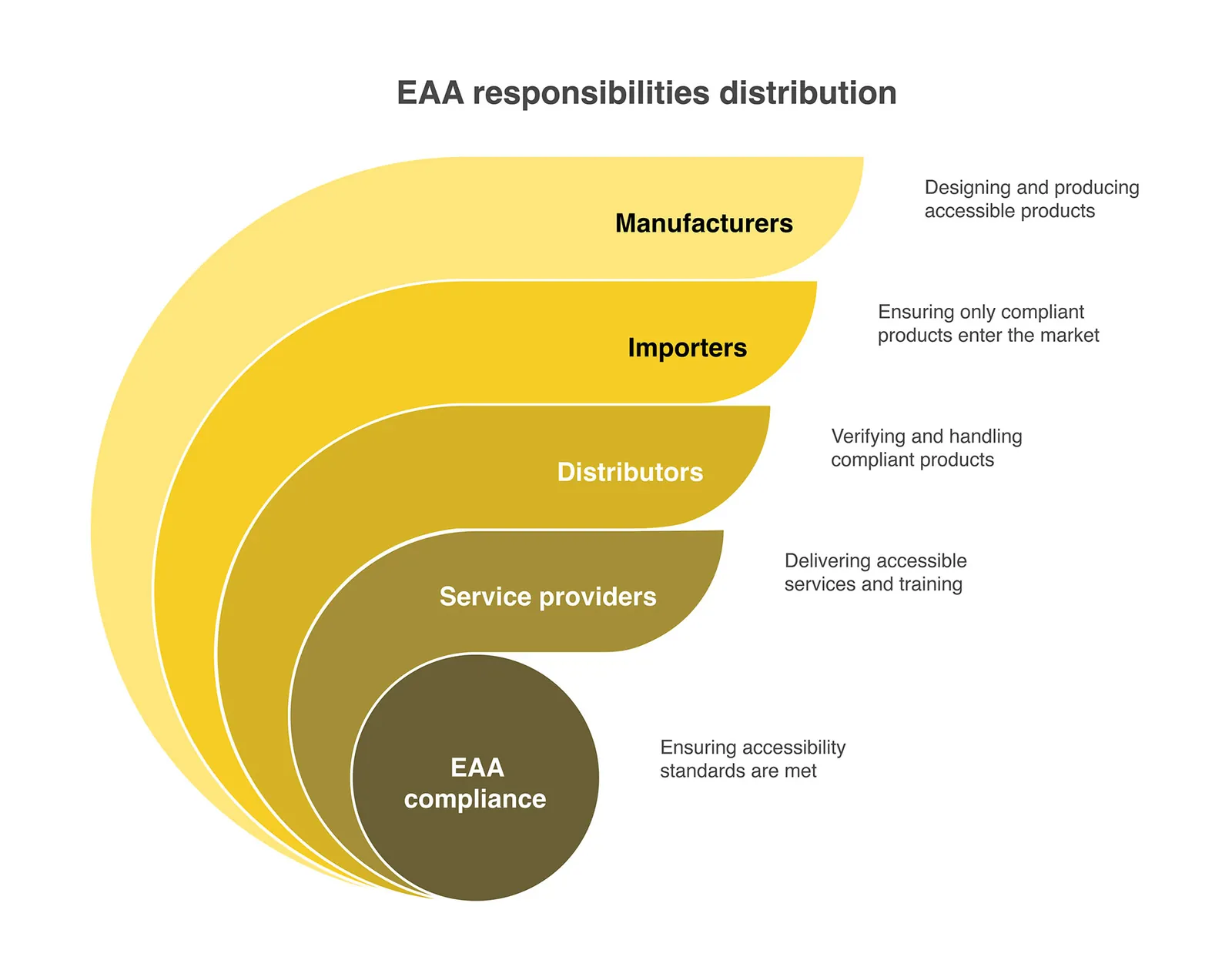
Which products and services are covered, and which are not
The Directive covers: consumer general-purpose computer hardware and operating systems; payment terminals and self-service terminals (ATMs, ticketing machines, check-in machines and interactive information terminals); smartphones and other interactive terminals used for electronic communications or for accessing audiovisual media; e-readers. Among services: electronic communications, access to audiovisual media services, air, bus, rail and waterborne passenger transport (websites, apps, e-tickets, travel information, terminals), consumer banking services, e-books, e-commerce and communications to the 112 emergency number.
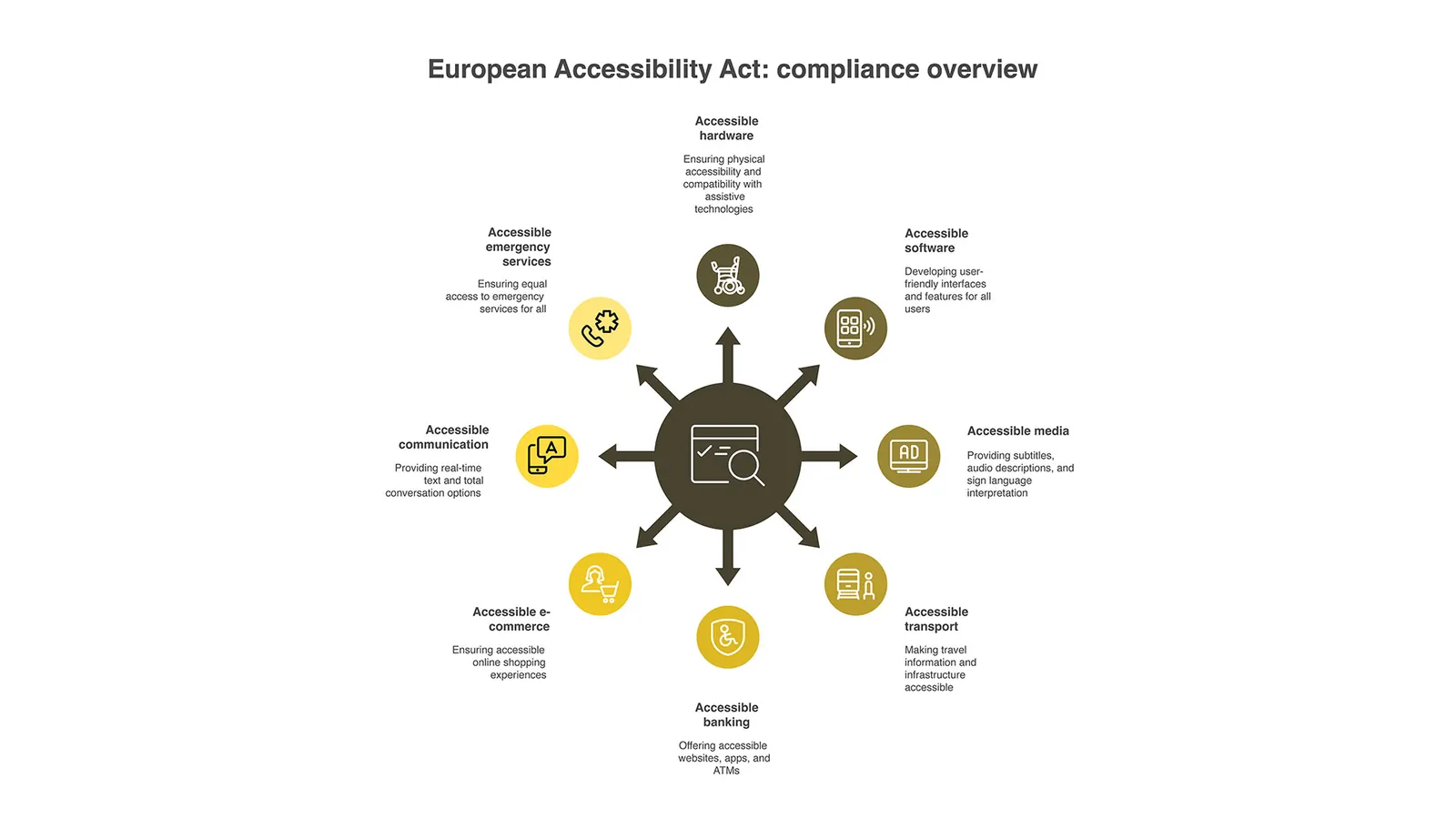
Furniture, cosmetics, clothing, kitchen utensils and industrial products not intended for consumers fall outside its direct scope. This does not mean that accessibility is irrelevant for them. When a product enters a building, the building’s rules apply: a washbasin in an accessible bathroom must comply with Ministerial Decree 236/1989 or Presidential Decree 503/1996. When it enters a public contract, the technical specifications must take accessibility into account. And when it enters a home in which someone is growing older, it responds to a market demand that grows every year.
Deadlines and exceptions
The obligation applies to products placed on the market and services provided from 28 June 2025. The legislation allows some leeway. Until 28 June 2030, service providers may continue to use products they were lawfully using before that date, and service contracts agreed before 28 June 2025 may continue unchanged until they expire, but for no longer than five years. Self-service terminals already installed may remain in use until the end of their economically useful life, and in any case for no longer than twenty years after they were put into use. Microenterprises providing services, that is, those with fewer than ten employees and an annual turnover, or annual balance sheet total, not exceeding two million euros, are exempt from the requirements.
This leeway concerns products already in use and contracts already signed. For a new product, there is only one way not to apply a requirement: to demonstrate, through a documented assessment that the authority can check, that it would require a fundamental alteration of the product’s nature or impose a disproportionate burden (Article 13 of Legislative Decree 82/2022). Anyone writing a brief today is already designing within the law.
Who enforces it and what the penalties are
In Italy enforcement is divided: the Agency for Digital Italy (AgID) for services, the Ministry of Enterprises and Made in Italy for products. If a product does not comply, the Ministry asks the economic operator to correct it within a set period and, failing that, orders its withdrawal from the market.
Administrative fines range from €5,000 to €40,000, graded according to the extent of the non-compliance, the number of products or services involved and the number of users; those who fail to comply with the authority’s requests or do not cooperate with inspections face fines of €2,500 to €30,000. For companies with an average turnover above €500 million that offer services through websites or applications, AgID can impose a fine of up to 5% of turnover (Article 24 of Legislative Decree 82/2022 and Article 9 of Legge 4/2004, the Italian law on the accessibility of IT tools). For services, in March 2026 AgID published its Linee guida sull’accessibilità dei servizi soggetti all’EAA (opens in a new tab) (guidelines on the accessibility of services subject to the EAA) and, with Determination No. 84 of 15 May 2026, the rules governing its inspections and sanctions procedure, which begins with a report of non-compliance and a deadline for correcting it.
The critical point: compliance after the fact
Since 28 June 2025 we have observed a recurring pattern among the companies we work with: they consulted their legal department, which produced a compliance checklist. The checklist was handed to the technical department, which added attributes to the documentation and revised the instructions for use. The product stayed exactly the same.
This approach has a precise name: retrofitting. It is the most expensive, and least effective, way of dealing with accessibility. The reasons are structural.
A product that was not designed for human diversity cannot become accessible through marginal changes. Accessibility is not added at the end of a design process: it is built in at the earliest stages, when the fundamental decisions on form, function, materials and interaction are still open.
Anyone who has already worked with the Design for All approach knows this from direct experience: integrating accessibility principles at the brief and concept stages reduces the cost of later adaptation, improves usability for all users, not just those with disabilities, and produces products that are more competitive, not less.
From compliance to competitive advantage: the role of Design for All
Around 90 million people with disabilities live in the European Union, 24% of the population aged 16 and over (2024). If we include older people (on 1 January 2025, 22.0% of the EU population was aged 65 or over; in Italy the figure was 24.7%, the highest in the Union), people with temporary disabilities, and the family members who influence purchasing decisions, the scope widens enormously. The full data are collected on the page on ageing and disability data in Europe.
Companies that brought Design for All into their research and development process before the EAA have a head start: human diversity was already in the brief, and the law now asks them to document what the design had already decided.
Competitive advantage is tested against precise indicators: product variants, returns, support requests, size of the audience reached at the same cost. How to measure them is explained in the article on the ROI of accessibility and the business case for Design for All.
Designing for the EAA from the brief: three actions
Integrating EAA principles from the start of the process essentially means doing three things:
- First: include users with different abilities in the research and testing stages. Not as a token statistical sample, but as a primary source of design requirements. It is the difference between knowing that an older person “might have difficulty” and understanding exactly where, why and how to change the concept.
- Second: set accessibility criteria in the design brief, not in the final specification. The question “is this product accessible?” must be asked when it has not yet been decided what the product will be, not when it is already in production.
- Third: test use with prototypes and with people before production, and at the same time build the technical documentation that compliance requires. User trials find what no documentary check can see; the documentation demonstrates what the trials have made possible. A checklist completed once the product is finished cannot correct a flawed concept.
The process, applied to physical products, is described in the article on accessibility and inclusive design in product design.
The right time to act is now
For companies developing new products or reassessing existing ranges, the time is now: not because the EAA imposes it as a bureaucratic emergency, but because the market demands it as a condition of competitiveness.
Companies that treat accessibility as a compliance problem are solving the wrong problem. Those that treat it as a design opportunity are building the competitive advantage of the next decade. The distinction is not semantic. It is strategic.
Since 2007 we have worked with companies, from bathroom furnishings to cosmetics, from electronics to cultural venues, to turn this distinction into solutions: the Prime washbasin, the Demì chopping board, products the EAA does not cover, designed for human diversity all the same. Not because it is ethically right, or not only for that reason: because a product designed for the diversity of people works better for everyone, and this shows in everyday use.
Frequently asked questions
When did the European Accessibility Act start to apply in Italy?
On 28 June 2025. Directive (EU) 2019/882 was transposed by Legislative Decree 82/2022, which applies to products placed on the market and services provided from that date.
Does a piece of furniture or a kitchen utensil fall under the EAA?
No: furniture, cosmetics, clothing and utensils fall outside the direct scope of the Directive. However, the rules of the building or public contract the product enters still apply and, above all, so does a market demand that grows as the population ages.
Are small businesses exempt?
Only microenterprises providing services (fewer than ten employees and an annual turnover or balance sheet total not exceeding two million euros) are exempt from the requirements. Microenterprises dealing with products must meet the requirements, but are not obliged to document their assessment of any disproportionate burden.
What penalties apply in Italy?
From €5,000 to €40,000 for breaches of the requirements; from €2,500 to €30,000 for failing to comply with the authority’s requests or to cooperate with inspections; up to 5% of turnover for companies with an average turnover above €500 million that offer services through websites or applications (Article 9 of Legge 4/2004). Non-compliant products can be withdrawn from the market.
Is a compliance checklist enough?
A checklist documents compliance; it does not produce it. If the product has already been defined, the possible changes are few and costly; the requirements need to be written into the brief, tested with prototypes and user trials with people, and documented as the law requires.
Sources
- Directive (EU) 2019/882, text on EUR-Lex (opens in a new tab)
- D.lgs. 27 maggio 2022, n. 82, on Normattiva (opens in a new tab) (Articles 13, 18, 21, 24, 25)
- Legge 9 gennaio 2004, n. 4, on Normattiva (opens in a new tab) (Article 9)
- European Commission, European Accessibility Act (opens in a new tab)
- AgID, Linee guida sull’accessibilità dei servizi soggetti all’EAA (opens in a new tab) (11 March 2026)
- AgID, Determinazione n. 84 del 15 maggio 2026 (Gazzetta Ufficiale No. 118 of 23 May 2026)
- Council of the European Union, Disability in the EU: facts and figures (opens in a new tab) (updated 16 July 2026)
- Eurostat, Population structure and ageing (opens in a new tab)
In our projects
Read next
- GuideThe ROI of accessibility: the economic dividend of Design for AllWhat is the return on investing in accessibility?
- EssayAccessibility and inclusive design: how to innovate in product designHow can accessibility drive product innovation without giving the product a clinical look?
- GuideLaw 13/1989 and the removal of architectural barriers: results and limitationsWhat has Law 13/1989 achieved, and where has it stopped short?
The law in the brief
We work with companies before the product is defined: requirements in the brief, user trials with people, and the documentation that compliance requires.