Bathroom design that people love page 1 of 10
Rodighiero Bathroom Design for All.
Bathroom design that people love. Design for All concepts for bathroom manufacturers.
Rodighiero.Design for All, forall.rodighiero.design
Foreword page 2 of 10
Accessibility and product identity, in the same design process.
We work with manufacturers to bring accessibility and product identity into the same design process.
Our contribution combines an approach shaped by Italian design culture with direct collaboration with people of different ages and abilities. We study how support, comfort and ease of use can become part of a product’s form and character.
Observation and Co-Design help us define the requirements. Sketches, full-scale models and prototypes allow us to explore the proposals and test them with users and with your technical team.
The aim is to develop distinctive products that support independence and fit naturally into homes, care settings and hotels.
We have developed two bathroom concepts of our own. We would welcome the opportunity to discuss with your team a research project built on your priorities.
Francesco Rodighiero, Designer, Rodighiero.Design for All
What we bring page 3 of 10
During a workshop, a participant told us that she asked for help fifteen times a day. Reducing that to thirteen, she said, would make a real difference.
We assess a bathroom product through its use: how it supports independence, how comfortable it is and how it fits the space.
Product identity. Supportive features are integrated into the product’s form and character, so that accessible products can sit naturally within the same bathroom range.
Co-Design. Observation and Co-Design help us develop concepts with people of different ages and abilities. We record the contributions, the needs identified, the resulting requirements and the findings from each round of testing.
Defined scope. The collaboration progresses through agreed stages, each with a defined scope and deliverables, giving your team a clear basis for deciding how to proceed.
Designing for the way people actually sit, reach and move.
The context page 4 of 10
The average user does not exist. Behind every figure there are people who adapt every day to products that were not designed for them. A bathroom is where this is felt most, and where a well-designed detail can make the greatest difference.
1 in 4 adults in the European Union report some form of disability: about 90 million people.
Long-standing limitations in usual activities, EU, 2025: 16.3% of people aged 16 to 64, 47.5% of people aged 65 or over, 58.1% of people aged 75 or over.
22.7% of Germany’s population was aged 65 or over on 1 January 2025; 27.7% is projected for 2050. 29.1% of the EU population is projected to be aged 65 or over by 2050, from 22.0% in 2025.
These are not separate markets. They are the everyday users of the next twenty years, often in the same hotel on the same day.
Sources: Council of the European Union, “Disability in the EU: facts and figures”, based on Eurostat 2024 estimates; Eurostat, hlth_silc_12, EU-SILC 2025; Eurostat, demo_pjanind, 2025; Eurostat, proj_25ndbi, EUROPOP2025 baseline scenario. Projections are scenarios, not forecasts. Full tables: forall.rodighiero.design/en/ageing-disability-europe-data
The process page 5 of 10
From understanding needs to developing a product.
Four phases follow an initial alignment with your team. Co-Design runs throughout the process, and testing may lead us to revisit earlier decisions. Each phase produces material for your team to review and use in the next stage.
Project alignment, before development. What we do: agree objectives, industrial constraints, responsibilities and the scope for change with your team. What you receive: a shared brief and agreed priorities for R&D, product management and marketing.
1 Listen. What we do: explore everyday use through observation, interviews and Co-Design activities selected for the project. What you receive: a documented set of user needs, organised by theme, with a map of issues and opportunities.
2 Understand. What we do: analyse the findings, review relevant standards and comparable products, and define design requirements. What you receive: a requirements document linking user needs, project objectives and constraints.
3 Design. What we do: develop concepts, sketches, full-scale models and prototypes with your technical team. What you receive: proposals and models for review and testing, with the design decisions explained.
4 Test. What we do: assess proposals with users against agreed criteria, and against an existing product where it provides a relevant baseline. What you receive: a test report recording findings, limitations and recommended design changes.
A single workshop can bring out hundreds of needs, including difficulties that people find hard to describe. A product can meet only a limited number of them well. Choosing which, making the trade-offs explicit and recording why is the designer’s responsibility.
Full-scale models, early in development page 6 of 10
Forearm support, grip and wheelchair approach need physical assessment. Early full-scale models complement digital development and help us refine dimensions, reach and comfort.
Images: section sketch of a washbasin; full-scale plywood model; 3D-printed elbow-rest prototypes; elbow-rest prototype, profile study; perspective sketch, developing the front edge.
Selected work page 7 of 10
Products in production, designed for a wide range of users.
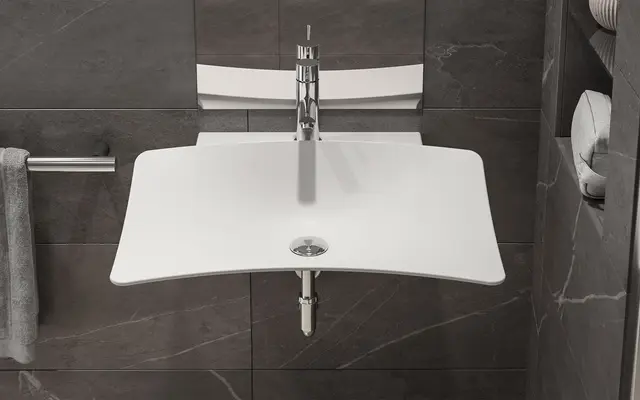
Shine, self-supporting wall-hung washbasin with elbow rests and a front edge inclined at 8 degrees.
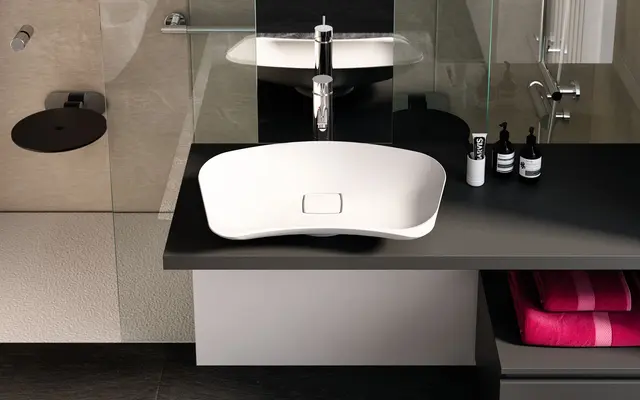
Prime, countertop washbasin developed through Co-Design: the concave front edge allows a seated approach.
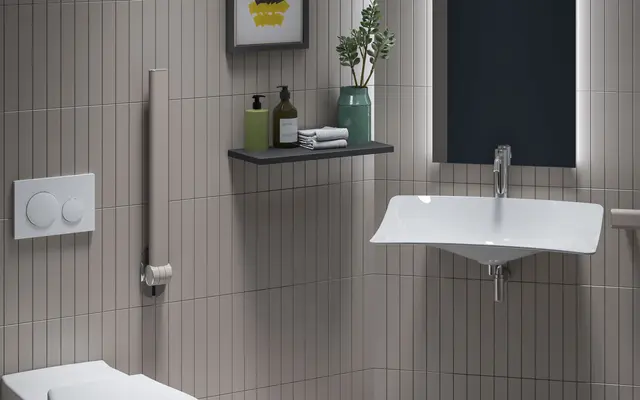
Shade, fold-away support rail: when not in use, it folds against the wall and leaves the space clear.
Working together page 8 of 10
A clear scope for each stage.
01 Concept presentation. We introduce the two concepts and discuss their potential for your range, after a non-disclosure agreement has been signed. A short introductory meeting, free of charge.
02 Focused development. We develop the selected concept with your technical team, agreeing requirements, models, prototypes and next steps. Scope and fees agreed for the project.
03 Evaluation. We assess the proposal against agreed criteria and, where relevant, against an existing product. User feedback and test findings inform the next decisions. Within the agreed development scope.
04 Range development. Where appropriate, the findings inform related products, shared components and specifications across the range. A further stage, agreed as needed.
Image: full-scale plywood model, assessing forearm support on the rim.
Confidentiality and intellectual property. Concepts are presented after a non-disclosure agreement has been signed. The scope of commissioned development, fees and any licensing arrangements are agreed before that work begins.
Documentation for your team. Each stage provides material for internal review: identified needs, agreed requirements, the rationale for key decisions and findings from testing, to support discussion across design, engineering, product management and marketing.
Recognition and network page 9 of 10
A studio, and a network behind it.
Awards and honours for products designed by the studio: iF Product Design Award 2011; German Design Award Nominee, Flight washbasin; ADI Design Index 2010 and 2019; Honourable Mention, XXVI Compasso d’Oro; ADI Well-Tech Award; Design for All Quality Mark, Gold level.
Design for All Italia and EIDD – Design for All Europe. Francesco Rodighiero has chaired Design for All Italia since 2020. The association was founded in 1994 as the Italian Institute for Design and Disability and was the first national member organisation of EIDD – Design for All Europe, the European network of Design for All organisations. Through this network, each project can draw on designers, researchers, universities and associations working on Design for All in Italy and across Europe.
Next step page 10 of 10
A research project for your range. A short meeting to define it.
We would welcome a short meeting to understand your priorities and define a research project with your team. Two bathroom concepts developed by the studio can be presented under a non-disclosure agreement. The meeting can take place in person or by video call.
+39 349 775 1763, francesco@rodighiero.design, linkedin.com/in/francescorodighiero, forall.rodighiero.design
Francesco Rodighiero is an industrial designer and a graduate of Politecnico di Milano. He has worked in Design for All and Inclusive Design since 2007. At Rodighiero.Design he designs products, spaces and services, integrating accessibility, usability and design quality, and provides consultancy and training for companies, museums and public bodies.